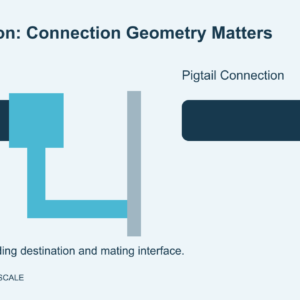

A connector IP rating applies to a specified configuration and test condition. It may change when you disconnect the interface. Before ordering a sealed harness, define protection during operation, storage and service. Check each connector half, required accessories and the finished assembly separately.

How Do You Read A Connector IP Rating?
Read the protection code together with its test standard, declared conditions and connector configuration.
The first characteristic numeral concerns solid-object protection. The second concerns water protection. Neither tells you whether the connector was tested disconnected.
For orientation, IP65 addresses dust-tight protection and water jets. IP67 combines dust-tight protection with temporary immersion protection.
IP68 addresses dust-tight protection and immersion under the applicable declared conditions. Request those conditions rather than assuming unlimited underwater service.
SGS’s IP-rating guide distinguishes the exposures and warns that immersion ratings do not necessarily establish lower water-protection ratings.
This matters when your equipment experiences both rain and cleaning jets. Ask for evidence covering the exposure you actually expect.
A higher-looking numeral is not a substitute for that review. Also preserve the precise designation used by the component manufacturer.
Your purchasing specification should identify the governing standard and revision. Avoid treating different standards or suffixes as interchangeable labels.
Use the code to define a controlled requirement. Do not use the word “waterproof” alone as your acceptance criterion.
Does A Connector IP Rating Apply When Unmated?
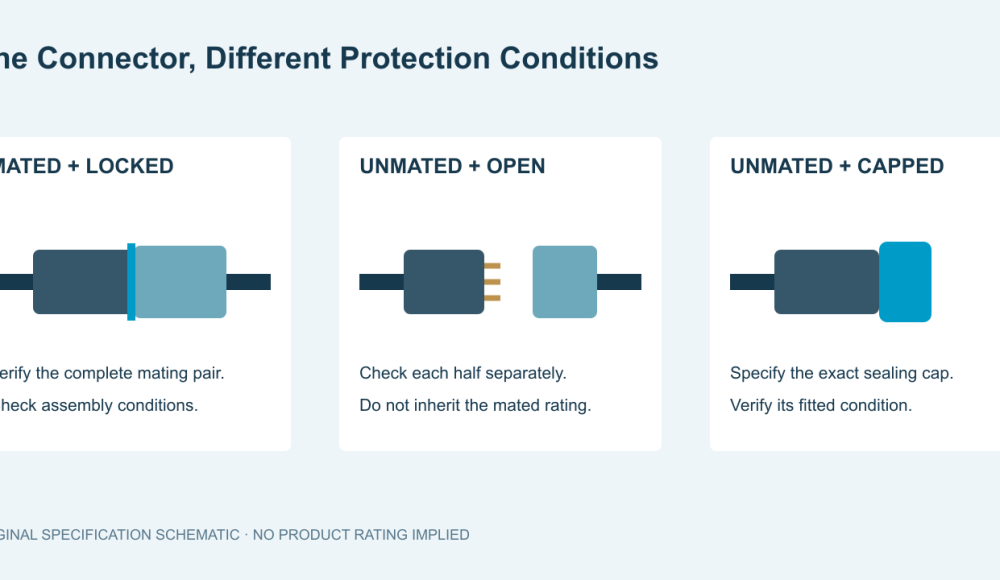
An IP rating applies when unmated only if the manufacturer specifies protection for that exact condition.
Do not read “IP67” as a promise for every state. Check whether the rating requires mating, locking, a backshell or a cap.
The distinction can differ within one product family. binder’s NCC documentation describes different mated and unmated ratings for selected panel connectors.
Those panel connectors use an automatic cover. Their behavior does not establish protection for every cable-side connector.
| Connection State | What You Must Confirm | Common Purchasing Gap |
|---|---|---|
| Mated And Locked | Exact mating pair, locking and assembly conditions | Only one housing part number is specified |
| Unmated, Uncapped | Separate unmated rating for each connector half | Mated rating is assumed to remain valid |
| Unmated, Capped | Cap compatibility, locking and stated protection | A shipping cover is treated as a sealing cap |
| During Connection | Permitted mating environment and handling procedure | Ingress protection is confused with wet-mating suitability |
How Do You Map Protection Across The Equipment Lifecycle?
List every exposed connection state, because normal operation may represent only part of the equipment’s service life.
Start with shipment and warehouse storage. A connector may arrive disconnected before the equipment enclosure exists.
Then consider installation. Your installer may route the cable through a dirty location before attaching its mating connector.
Finally, review maintenance and replacement. A normally sealed interface can remain open while a technician removes a module.
| Equipment Situation | Protection Question | Specification Action |
|---|---|---|
| Outdoor sensor installation | Will either half remain open before commissioning? | Define temporary protection and installation handling. |
| Detachable lighting module | What protects the unused connection after removal? | Specify a rated cap or a documented protected interface. |
| Agricultural equipment service | Can cleaning reach the disconnected cable end? | Define the service state and permitted cleaning procedure. |
| Washdown equipment | Is cleaning performed with all connectors locked? | Align the cleaning procedure with the validated configuration. |
| Panel-mounted control unit | Does the requirement include the panel seal? | Include representative mounting conditions in the test boundary. |
These are planning examples, not claims that a particular connector suits those applications.
You may need different requirements for operation and temporary storage. State each requirement explicitly instead of choosing one headline rating.
If exposure cannot be controlled during service, escalate that requirement before freezing the connector selection.
Which Accessories Are Part Of The Rated Configuration?
Required accessories belong in your approved assembly BOM, not an optional shopping list.
For example, TE’s NTSEAL FAQ states its listed sealing levels with a backshell. This condition matters when you compare quotations.
A quotation excluding required hardware does not describe the same assembly. Confirm the manufacturer’s current drawing and application specification.
- List both mating housings and their exact variants.
- Identify required backshells, seals, cavity plugs and cable fittings.
- Specify compatible cable or wire dimensions.
- Include the cap for each interface needing disconnected protection.
- Reference assembly instructions, locking requirements and relevant revisions.
Match individual wire seals to the approved wire insulation. Our wire seal selection guide explains that separate compatibility check.
Keep Sealing And Locking Requirements Together
A connector can look assembled while its locking mechanism remains incomplete. Follow the specified engagement or torque instructions.
Do not invent one tightening torque for different connector sizes. Thread design, material and manufacturer instructions determine the installation requirement.
Where position-assurance devices are specified, include their correct state in inspection. Do not treat electrical contact as proof of full engagement.
The RFQ should identify who supplies the mating half. Otherwise, the harness supplier may lack the hardware needed for representative inspection.
When your equipment uses a customer-supplied panel connector, provide its part number and mounting details with the cable assembly drawing.
Can A Protective Cap Preserve The Unmated Rating?
A protective cap can provide specified protection only when its manufacturer rates the compatible, correctly installed combination.
A dust cover, shipping plug and environmental sealing cap are not interchangeable descriptions. Confirm the part number and its operating condition.
binder’s cap announcement describes rated caps for selected cable connectors. It also distinguishes cable-side protection from panel-side automatic covers.
Specify where the cap stays during use. Include tether clearance and access for inspection or replacement.
Do not cap a contaminated or wet interface without following the equipment’s approved handling procedure. A cap cannot reverse previous ingress.
Does An IP-Rated Connector Make The Harness IP-Rated?
A connector component rating does not establish the ingress protection of your complete harness or equipment.
Your assembly introduces additional interfaces. Wire entry, unused cavities, cable exits and panel mounting may each require separate controls.
Define the assembly boundary before specifying acceptance. Is the requirement for the mating interface, cable assembly or installed enclosure?
Also separate ingress protection from chemical resistance, corrosion durability and repeated flexing. Specify those exposures independently when relevant.
Do not infer pressure-wash performance from an immersion claim. Request the exact test designation and conditions your application requires.

What Assembly Details Can Undermine Sealing?
Incorrect interfaces or assembly damage can undermine the intended sealing arrangement even when the housing part number is correct.
Wire Entry And Unused Cavities
Check the actual wire insulation diameter against the specified seal range. Conductor gauge alone does not identify that diameter.
Also identify unused positions on the cavity map. Your drawing should state the approved method for closing those positions.
TE’s seals and cavity-plugs guidance treats these as components selected for particular wires and connector cavities.
Do not fill an unused cavity with an improvised wire stub. Use the manufacturer-approved configuration and preparation instructions.
Seal Damage And Contamination
Inspect sealing features for cuts, displacement and trapped debris where accessible. Define the inspection stage before those features become hidden.
A second assembly attempt does not automatically restore a damaged seal. Follow the applicable replacement and rework instructions.
Keep protective features clean during handling. Define approved cleaning methods rather than applying an unverified solvent to sealing materials.
Cable Loading And Panel Installation
Route the cable so the installed assembly matches the intended support conditions. Review bending and side loading near the connector.
Strain relief manages mechanical loading, while sealing manages ingress. One feature should not be assumed to replace the other.
At panel interfaces, review the cutout, mounting surface and specified gasket. Include relevant installation details in the controlled drawing.
Record these conditions when approving the sample. A loose bench assembly may not represent the installed equipment.
How Should You Specify Inspection And Testing?
Specify the test boundary, connection state and acceptance criteria before requesting an ingress-protection claim.
- Identify the exact assembled sample and mating hardware.
- State whether it is mated, locked, uncapped or capped.
- Reference the required standard, revision and test conditions.
- Define any conditioning, flexing or mating cycles before exposure.
- State inspection criteria and any electrical checks after exposure.
- Agree sampling, reporting and who performs the test.
Visual inspection can check seal presence, damage and assembly details. It does not replace an agreed ingress test.
Electrical continuity likewise does not prove a watertight assembly. Keep circuit checks and ingress acceptance as separate requirements.
For a panel-mounted assembly, include the relevant panel features and installation conditions. A connector-only sample may omit that sealing interface.
Request evidence matching your BOM and configuration. A report for a different cable diameter or accessory combination needs engineering review.
How Do You Separate Qualification From Production Inspection?
Qualification evaluates a defined design and configuration; production inspection checks agreed features on subsequent assemblies.
You need both scopes written down. A qualification report does not automatically mean every shipped harness receives the same exposure test.
Similarly, checking every connector visually does not establish that the design passed its required ingress test.
Define The Qualification Sample
Record the exact cable, housings, seals, accessories and assembly revision. Include the representative mating connector and panel when required.
If your test includes prior conditioning, record its sequence. Exposure after mechanical conditioning answers a different question from exposure beforehand.
Specify test responsibility and the required report. Clarify whether independent laboratory work is necessary before the supplier confirms its quotation.
Define The Production Checks
Agree which features are inspected, when they are inspected and how results are recorded. State sampling separately from acceptance limits.
Your plan might address seal installation, cavity closure, connector engagement and cable-entry assembly. Select checks for the actual construction.
If a routine leak test is proposed, define its method and validated relationship to your acceptance requirement.
Do not assume that an air-leak result directly equals a specified water-ingress rating. Any correlation needs an appropriate technical basis.
Control Changes After Approval
Review substitutions before release, including seals, cable materials and accessories. Ask whether the change affects the evidence supporting your configuration.
Some changes may require additional evaluation or testing. The decision should follow your approved change-control requirements.
Keep the approved sample, drawing and report references aligned. Otherwise, procurement may reorder a configuration different from the qualified sample.
Check Whether The Test Report Matches Your Assembly
Read the report’s sample description before relying on its headline result. Check whether both connector halves and required accessories are identified.
Look for the cable specification and assembly revision. A similar housing photograph cannot resolve differences in wire entry or rear sealing.
Check whether the sample was mated, capped or open during testing. Record which sides were exposed and which boundaries were excluded.
Then compare the test conditions with your drawing. Depth, duration, spray conditions and sample orientation must follow the applicable requirement.
Review the stated acceptance criteria and observations. Do not convert a test result into a broader claim than the report supports.
Ask how the sample was examined after exposure. Your equipment requirements may also call for electrical checks under defined conditions.
Confirm whether the report includes prior conditioning. A new connector and a mechanically conditioned connector represent different sample states.
If an enclosure fixture was used, identify it. Your production panel must match the relevant sealing conditions or receive separate review.
Finally, confirm who approved the evidence for your program. Keep that decision linked to the drawing and procurement specification.
This review does not require every project to use identical documentation. It ensures the evidence answers your actual purchasing question.
What Should You Send With A Sealed Harness RFQ?
Send the complete connector configuration and its exposure states so suppliers quote the same protection scope.
- Drawing, pinout, cable specification and complete accessory BOM
- Operating, storage and maintenance connection states
- Required ingress designation and test conditions
- Wire entry, unused cavity and panel mounting details
- Cap requirements and service handling instructions
- Sample quantity, production quantity and annual demand
- Required inspection records and qualification reports
Caps, backshells, assembly access and qualification samples affect cost. Compare these items explicitly instead of comparing housing prices alone.
What Does A Clear Sealed-Harness Specification Look Like?
A clear specification connects the required protection state to named components, controlled assembly details and agreed evidence.
The following example is a drafting framework. It is not a customer case or a declaration of XSD test performance.
| Drawing Or Purchase-Order Field | What You Should Write |
|---|---|
| End A connection | Approved housing, contacts, seals, accessories and mating connector references. |
| End A operating state | Required protection designation with the interface fully mated and locked. |
| End A service state | Required disconnected protection, approved cap and fitted condition, where applicable. |
| End B installation | Panel geometry, gasket and installation reference when part of the required boundary. |
| Exposure conditions | Required standard, revision, test conditions and any additional real-world exposure requirements. |
| Acceptance evidence | Applicable component documents, assembly qualification report and routine inspection records. |
| Change control | Approval requirements for component, material, accessory or assembly changes. |
Replace every generic field with project-specific information before release. Do not leave the final requirement to a sales description.
For instance, “sealed connector with cap” leaves several questions unanswered. Which half needs the cap, and during which exposure?
Ask the supplier to identify exclusions in its quotation. This makes missing mating hardware or special testing visible before purchase.
Compare quotations against the same BOM, connection states and documentation scope. A lower quote may simply omit a required accessory.
Separate one-time qualification costs from recurring assembly costs. This helps you assess prototype spending and later production pricing.
Also define replacement parts for field service. A production-approved cap or seal needs an identifiable purchasing reference.
When drawings cannot capture the handling sequence clearly, add a controlled work instruction. Keep its revision linked to the assembly specification.
How Can XSD Review Your Sealed Harness?
XSD can review your build-to-print harness configuration and the manufacturing and inspection scope it requires.
The waterproof wiring harness page outlines application inputs for sealed assemblies.
Published manufacturing capabilities include wire processing, terminal crimping, connector assembly and electrical inspection.
Send special ingress testing and reporting requirements for review. Do not assume every assembly receives the same environmental test.
Company certificates on the quality assurance page are distinct from qualification of your finished harness.

Frequently Asked Questions
Use the exact part specification and assembled state to resolve protection questions.
Does IP67 Mean The Open Contacts Are Protected?
Not necessarily. Check the specified unmated protection for that connector half.
Do Both Halves Have The Same Unmated Rating?
Do not assume so. A panel connector with an automatic cover may differ from its cable-side mate.
Is A Shipping Cap Enough For Outdoor Storage?
Only if its documented protection and conditions match your requirement. Specify a compatible rated cap where necessary.
Can You Omit A Backshell If The Contacts Still Work?
Not when the rated configuration requires it. Electrical operation does not establish sealing performance.
Can An IP-Rated Connector Be Connected Underwater?
Only when the manufacturer explicitly permits that operation. A sealed mated state does not establish wet-mating suitability.
Does Overmolding Automatically Preserve The Rating?
No. Material, geometry, adhesion and component interfaces need review. Validate the actual assembly against its requirements.
Can The Supplier Use A Similar Connector?
Require approval before substitution. Similar appearance does not establish compatible mating, sealing or documentation.
What Evidence Should You Request Before Production?
Request the applicable component documents, approved assembly configuration and agreed inspection or test evidence.
Specify Every Connection State Before You Order
Send your drawing, complete BOM and protection requirements for operation, storage and service. Include quantities and required reports. Contact us to review your sealed harness requirements.