
For OEMs, engineers, and purchasing teams sourcing custom wiring harnesses, understanding crimp quality is essential when evaluating a wire harness manufacturer.
This guide explains the most common crimping challenges, their causes, quality-control methods, testing requirements, and what to consider when selecting a reliable custom wire harness manufacturer.
What Is Crimping in Wire Harness Manufacturing?
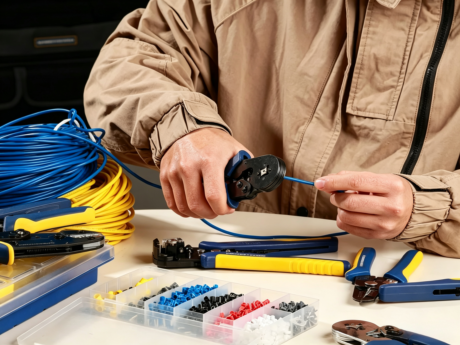
Crimping is the process of mechanically joining a wire conductor to a terminal or contact by controlled deformation of the terminal.
Unlike soldering, crimping creates the electrical and mechanical connection through controlled compression between the terminal and conductor.
A reliable crimp must provide:
- Stable electrical conductivity
- Adequate mechanical retention
- Consistent contact resistance
- Protection against conductor damage
- Repeatable performance during production
Because every crimp becomes part of the electrical path, crimp quality directly influences the reliability of the finished wire harness assembly.
Why Is Crimping Critical to Wire Harness Reliability?
A wire harness can contain dozens, hundreds, or even thousands of individual termination points. A single defective crimp can therefore affect the performance of an entire electrical system.
Electrical Reliability
An improper crimp can create excessive contact resistance. As resistance increases, heat may be generated at the connection, potentially resulting in:
- Voltage drop
- Intermittent electrical signals
- Circuit failure
- Overheating
- Premature connection degradation
Mechanical Reliability
The terminal must also hold the conductor securely.
A weak crimp can allow the wire to pull out of the terminal during:
- Installation
- Vibration
- Repeated movement
- Mechanical loading
- Equipment operation
What Happens When a Crimp Fails?
The typical failure chain can be summarized as:
Incorrect crimp → Poor electrical or mechanical connection → Intermittent fault or open circuit → System failure
For this reason, crimping should be treated as a controlled manufacturing process—not simply a routine assembly operation.
What Makes Wire Harness Crimping Challenging?
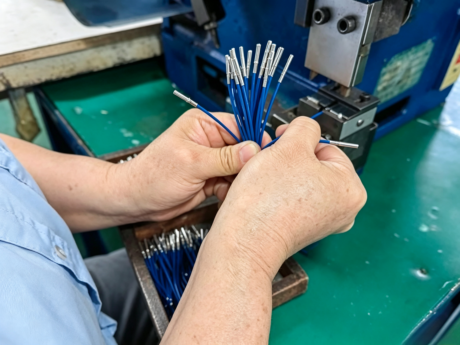
Reliable crimping depends on several variables working together. A problem with any one of them can affect the finished connection.
Wire Selection
The wire must be compatible with the selected terminal and application.
Important factors include:
- Wire gauge
- Conductor construction
- Number and size of strands
- Insulation type
- Electrical requirements
Terminal Selection
The terminal must be appropriate for the wire and application.
Incorrect wire-to-terminal matching can result in poor mechanical retention or unreliable electrical performance.
Crimp Tooling
The crimping tool and applicator must match the terminal manufacturer’s requirements.
Tooling geometry directly affects how the terminal is compressed around the conductor.
Crimp Parameters
Important parameters can include:
- Crimp height
- Crimp width
- Terminal position
- Conductor insertion
- Insulation support
These parameters must be controlled consistently during production.
Wire Preparation
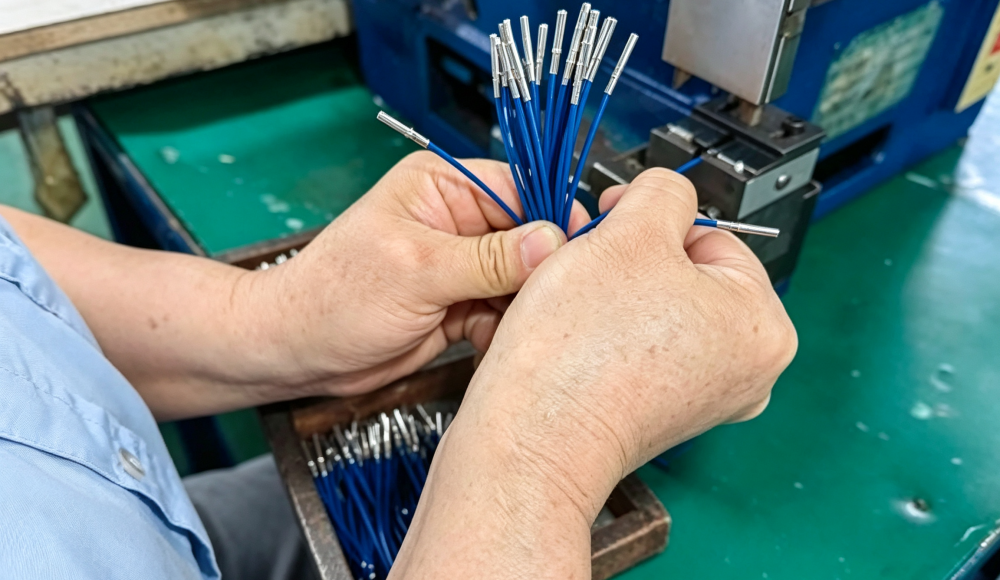
Wire cutting and stripping also affect crimp quality.
Incorrect strip length, damaged conductors, or improper wire insertion can compromise the final connection even when the crimping tool itself is functioning correctly.
Process Control
Consistent crimping requires:
- Correct equipment
- Proper setup
- Calibration
- Operator training
- Defined inspection procedures
- Production traceability
This is why experienced wire harness manufacturers treat crimping as a controlled process with measurable quality requirements.
What Are the Most Common Wire Harness Crimping Problems?
1. Under-Crimping
Under-crimping occurs when the terminal is not compressed sufficiently around the conductor.
Potential consequences include:
- Poor electrical contact
- High resistance
- Insufficient mechanical retention
- Terminal pull-out
- Intermittent electrical faults
The solution is controlled tooling setup and verification of the specified crimp dimensions.
2. Over-Crimping
Over-crimping occurs when excessive force compresses the terminal.
Potential consequences include:
- Damaged conductor strands
- Terminal deformation
- Reduced conductor cross-section
- Reduced mechanical strength
- Unstable electrical performance
A crimp must provide sufficient compression without damaging the conductor.
3. Incorrect Wire-to-Terminal Matching
Not every terminal is suitable for every wire.
The wire gauge, conductor construction, terminal specification, and crimping tooling must be compatible.
Using an incorrect combination can lead to:
- Poor conductor compression
- Insufficient retention
- Excessive deformation
- Electrical performance problems
For custom wiring harnesses, correct component selection should therefore be established before production.
4. Incorrect Wire Strip Length
Strip length is another important variable.
If too much insulation is removed, excessive conductor may be exposed.
If too little insulation is removed, the conductor may not be correctly positioned inside the terminal barrel.
A controlled stripping process helps ensure consistent conductor and insulation positioning.
5. Damaged Wire Strands
Wire strands can be damaged during cutting, stripping, insertion, or crimping.
Damaged or missing strands reduce the effective conductor cross-section and can compromise the mechanical and electrical performance of the connection.
Careful wire processing and appropriate tooling are therefore essential.
6. Incorrect Terminal Positioning
The conductor must be correctly positioned within the terminal before crimping.
Incorrect positioning can affect:
- Conductor crimp location
- Insulation support
- Mechanical retention
- Electrical contact
Standardized work instructions and appropriate fixtures can reduce positioning errors.
7. Worn or Improperly Calibrated Crimping Tools
Crimping tools are subject to wear during repeated production.
Tool wear or incorrect setup can cause process variation and inconsistent crimp dimensions.
Professional manufacturers should establish appropriate:
- Tool inspection
- Maintenance
- Calibration
- Setup verification
procedures.
8. Inconsistent Operator Technique
Manual crimping can introduce variation when operators have different levels of training or follow inconsistent procedures.
Clear work instructions, operator training, standardized processes, and defined inspection requirements help minimize variation.
What Causes Crimping Defects?
Crimping defects typically result from several categories of root causes.
| Root Cause | Typical Example |
| Design | Incorrect terminal or wire specification |
| Material | Incorrect wire or terminal |
| Equipment | Unsuitable crimping machine |
| Tooling | Incorrect or worn applicator |
| Process | Incorrect crimp parameters |
| Operator | Incorrect wire insertion |
| Inspection | Insufficient crimp verification |
| Maintenance | Tool wear or calibration issues |
This is why correcting a defective crimp requires more than simply replacing the terminal. A professional manufacturer should identify the root cause and correct the underlying process.
How Do Professional Manufacturers Control Crimp Quality?
Reliable crimping requires quality control from engineering through final inspection.
1. Engineering Review
Before production, the manufacturer should review:
- Wire specifications
- Terminal specifications
- Connector requirements
- Crimp requirements
- Drawings
- BOM
- Customer specifications
This helps identify potential compatibility or manufacturability problems before production begins.
2. Correct Tooling Selection
The crimping equipment and tooling must be appropriate for the terminal and wire combination.
Incorrect tooling can produce inconsistent or unacceptable crimps even when operators follow the correct procedure.
3. First-Piece Inspection
The first completed crimp should be verified before continuing production.
This helps identify setup problems at the beginning of a production run rather than after large quantities have been processed.
4. Crimp Height Measurement
Crimp height is an important process-control parameter.
Regular measurement helps verify that the terminal is being compressed consistently according to the applicable specification.
5. Pull-Force Testing
Pull-force testing evaluates the mechanical strength of the wire-to-terminal connection.
It can help identify problems such as:
- Insufficient crimping
- Incorrect wire-terminal combinations
- Poor conductor insertion
- Process variation
6. Cross-Section Analysis
A cross-section or microsection inspection allows manufacturers to examine the internal crimp geometry.
It can reveal conditions that may not be visible through external inspection, including conductor compression, strand positioning, and terminal deformation.
7. Tool Calibration and Maintenance
Crimping equipment should be maintained and calibrated according to applicable equipment, tooling, and process requirements.
Regular control helps reduce variation caused by equipment wear.
8. Operator Training
Operators should understand:
- Correct wire preparation
- Terminal positioning
- Tool operation
- Defect identification
- Inspection procedures
For critical production environments, standardized training and qualification help maintain consistency.
9. Process Monitoring and Traceability
Quality records can help manufacturers identify:
- Production lots
- Inspection results
- Test results
- Equipment information
- Operator information
- Calibration status
Traceability becomes particularly valuable when investigating quality issues or supporting customer audits.
How Is Wire Harness Crimp Quality Tested?
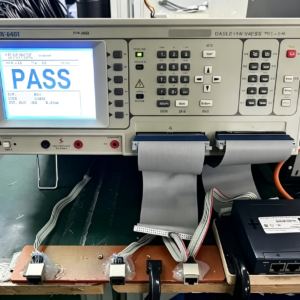
A professional wire harness assembly manufacturer may use multiple inspection and testing methods depending on the product and customer requirements.
| Test Method | What It Verifies |
| Visual inspection | External workmanship and obvious defects |
| Crimp height measurement | Crimp process consistency |
| Pull-force testing | Mechanical retention |
| Cross-section analysis | Internal crimp geometry |
| Continuity testing | Correct electrical connections |
| Insulation testing | Electrical isolation where applicable |
| Hi-pot testing | Dielectric withstand where applicable |
No single inspection method can identify every possible defect.
For this reason, an effective quality system combines process control, mechanical inspection, and electrical testing.
Wire Harness Crimping Standards and Quality Requirements
The applicable standard depends on the industry, product, and customer requirements.
One of the key workmanship standards for cable and wire harness assemblies is IPC/WHMA-A-620, which provides requirements and acceptance criteria for harness assembly workmanship.
Depending on the application, manufacturers may also need to consider:
- Automotive quality requirements
- Aerospace quality requirements
- UL requirements
- SAE requirements
- IEC requirements
- Customer-specific engineering specifications
For this reason, a wire harness manufacturer should review the customer’s drawings, specifications, and applicable standards before production.
The objective is not simply to manufacture a harness that looks correct. The harness must meet the electrical, mechanical, environmental, and quality requirements of its intended application.
Manual vs. Semi-Automatic vs. Automatic Crimping
The appropriate crimping method depends on wire size, terminal type, production volume, product complexity, and required consistency.
| Crimping Method | Typical Application | Main Advantage | Main Consideration |
| Manual | Prototypes and low-volume production | Flexible | More operator-dependent |
| Semi-automatic | Medium-volume production | Improved consistency and efficiency | Requires appropriate tooling |
| Automatic | Higher-volume production | High repeatability and throughput | Higher setup and tooling requirements |
A capable custom wire harness manufacturer should select the appropriate production method based on the actual project requirements rather than using one process for every product.
What Should You Look for in a Wire Harness Manufacturer?
When outsourcing custom wiring harness production, crimping capability should be one of the supplier’s key technical evaluation criteria.
Consider asking the manufacturer:
Can you review our wire and terminal specifications?
A capable supplier should be able to identify potential compatibility or manufacturing issues before production.
How do you control crimp quality?
Ask about crimp height, tooling control, pull-force testing, cross-section analysis, and production inspection.
How do you manage crimping tools?
Tool selection, maintenance, setup, and calibration are important indicators of manufacturing process control.
Can you perform electrical testing?
Ask whether the finished harness can be tested according to your requirements, such as continuity, insulation, or dielectric testing where applicable.
Can you provide quality documentation?
Depending on the application, you may require inspection records, test results, certificates, or production traceability.
Can you support prototypes and production?
For new products, it is beneficial to work with a supplier capable of supporting the project from prototype through production.
How XSD Harness Approaches Custom Wire Harness Manufacturing
For a custom wiring harness, reliable crimping is only one part of the overall manufacturing process.
A complete harness requires coordinated control of:
Engineering → Material Selection → Wire Processing → Crimping → Connector Assembly → Harness Routing → Electrical Testing → Final Inspection
At XSD Harness, customers can provide technical information such as:
- Wire harness drawings
- Wiring diagrams
- BOMs
- Connector specifications
- Terminal specifications
- Samples
- Product requirements
The manufacturing requirements can then be reviewed before production.
For projects where crimp quality is critical, customers should communicate the applicable wire, terminal, testing, inspection, and quality requirements as early as possible.
This helps ensure that the manufacturing process is aligned with the product’s actual requirements from the beginning.
FAQs About Wire Harness Crimping
What is crimping in a wire harness?
Crimping is the controlled mechanical deformation of a terminal around a wire conductor to create an electrical and mechanical connection. It is one of the most important processes in custom wire harness manufacturing.
What causes a bad wire crimp?
Common causes include incorrect wire-to-terminal matching, improper strip length, incorrect crimp parameters, unsuitable tooling, tool wear, poor wire positioning, and inconsistent operator technique.
How do you know if a wire crimp is good?
Crimp quality can be evaluated using appropriate methods such as visual inspection, crimp-height measurement, pull-force testing, cross-section analysis, and electrical testing, depending on the application and applicable specifications.
What is crimp height?
Crimp height is a dimensional measurement used to help control the compression of a terminal around the conductor. It is an important parameter for maintaining consistent crimp quality.
How do you test wire harness crimp quality?
Common methods include visual inspection, crimp-height measurement, pull-force testing, cross-section analysis, continuity testing, and other electrical tests required by the application.
Why is proper wire stripping important for crimping?
Incorrect strip length can result in improper conductor positioning, excessive exposed conductor, or insufficient conductor insertion. Consistent stripping is therefore essential for repeatable crimp quality.
What standards apply to wire harness crimping?
IPC/WHMA-A-620 is a key workmanship standard for cable and wire harness assemblies. Additional automotive, aerospace, UL, SAE, IEC, and customer-specific requirements may apply depending on the product.
Can a custom wire harness manufacturer handle terminal crimping?
Yes. Professional wire harness manufacturers commonly provide wire cutting, stripping, terminal crimping, connector assembly, harness assembly, electrical testing, and related services according to customer specifications.
What should I provide when requesting a wire harness quotation?
Useful information includes drawings, wiring diagrams, BOMs, wire specifications, terminal and connector part numbers, quantities, annual demand, testing requirements, packaging requirements, and applicable quality standards.
Need a Reliable Custom Wire Harness Manufacturer?
Crimping is a small operation within the overall wire harness assembly process, but its impact on electrical and mechanical reliability can be significant.
A reliable custom wiring harness requires more than correct components. It requires correct wire and terminal selection, controlled tooling, consistent crimp parameters, qualified operators, appropriate inspection, and electrical verification.
If you are developing a new product or looking for a supplier for an existing wire harness, XSD Harness can review your drawings, BOMs, wiring diagrams, terminal specifications, or samples to understand your manufacturing requirements.
Send your wire harness drawings or specifications to XSD Harness for a project review and quotation.