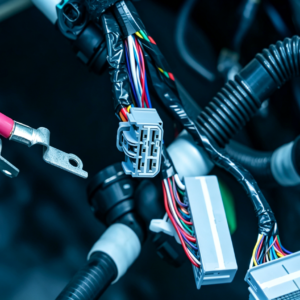

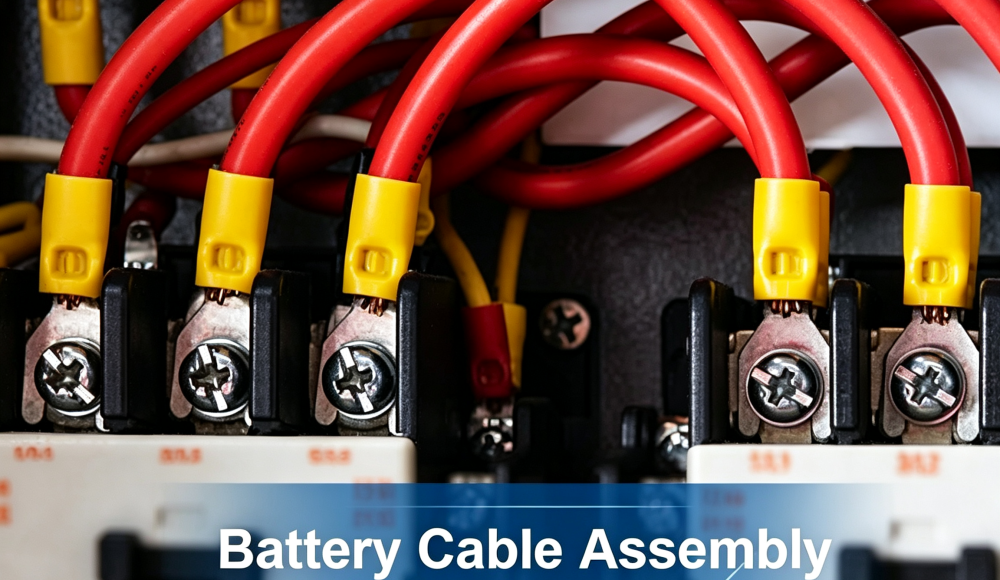
A complete battery cable assembly can include a cable, conductor, insulation, battery terminals, ring terminals or cable lugs, connectors, heat-shrink tubing, protective sleeving, and other application-specific components.
Choosing the correct cable size is only one part of the engineering process. A reliable battery cable assembly must also have the right conductor material, insulation, cable length, terminal design, crimping method, routing, environmental protection, and testing requirements.
This guide explains battery cable assembly types, components, applications, cable sizing considerations, terminal selection, common failure causes, testing methods, custom design requirements, and how to select a reliable battery cable assembly manufacturer.
What Is a Battery Cable Assembly?
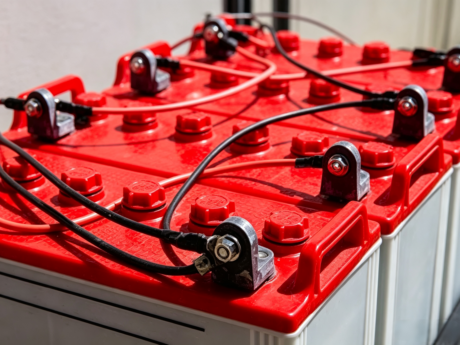
A battery cable assembly is a pre-assembled electrical cable designed to transfer power between a battery and another electrical component or distribution point.
Unlike a bare battery cable sold by length, a battery cable assembly is normally manufactured to a specific configuration and may include:
- Battery cables
- Copper or other conductors
- Insulation
- Battery terminals
- Ring terminals or cable lugs
- Connectors
- Heat-shrink tubing
- Protective sleeving
- Corrugated tubing
- Fuse links or related protection
- Labels
- Mounting or fastening components
The assembly is designed according to the electrical and mechanical requirements of the final product.
Battery Cable vs. Battery Cable Assembly
A battery cable generally refers to the cable itself.
A battery cable assembly is a finished component that combines the cable with the required termination and protection components.
For example:
Battery Cable
Cable + Insulation
Battery Cable Assembly
Cable + Insulation + Terminals + Protection + Required Connectors / Components
This distinction is important when purchasing from a manufacturer. OEM customers usually need a finished cable assembly that is ready for installation, rather than a length of cable that requires additional cutting, stripping, crimping, and termination.
What Are the Main Components of a Battery Cable Assembly?
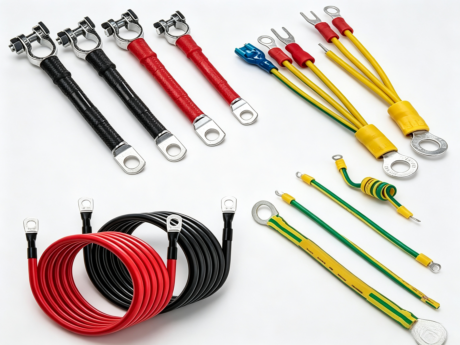
The exact construction depends on the application, but most battery cable assemblies contain several core components.
1. Conductor
The conductor carries electrical current between the battery and connected electrical equipment.
Copper is commonly selected for applications requiring good electrical conductivity and reliable current transmission.
Conductor size is one of the most important design parameters because it affects:
- Current-carrying capability
- Electrical resistance
- Voltage drop
- Heat generation
- Cable flexibility
- Overall weight and cost
2. Insulation
Insulation protects the conductor from:
- Electrical contact
- Moisture
- Abrasion
- Heat
- Chemicals
- Environmental exposure
The insulation material should be selected according to the actual operating environment.
3. Battery Terminals
Battery terminals provide the connection between the cable assembly and the battery.
Depending on the application, the assembly may use:
- Battery post terminals
- Ring terminals
- Cable lugs
- Right-angle terminals
- Specialty terminals
4. Connectors
Some battery cable assemblies use connectors to provide a detachable connection to other components.
Connector selection should consider:
- Current
- Voltage
- Pin configuration
- Mechanical retention
- Environmental protection
- Available installation space
5. Heat-Shrink Tubing
Heat-shrink tubing can provide:
- Electrical insulation
- Strain relief
- Environmental protection
- Terminal-area protection
- Improved appearance
6. Protective Sleeving and Tubing
Depending on the application, additional protection may be required against:
- Abrasion
- Heat
- Vibration
- Chemicals
- Moisture
- Mechanical damage
How Does a Battery Cable Assembly Work?
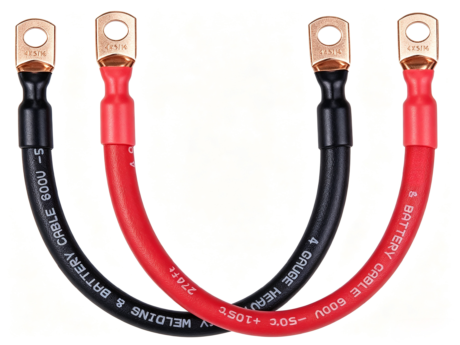
A battery cable assembly provides a controlled electrical path between a battery and an electrical load or grounding point.
In a typical low-voltage vehicle system, the positive cable transfers power from the battery toward the electrical system or starter, while the negative cable provides the return path through the battery ground system.
A simplified power path is:
Battery → Positive Cable → Electrical Load
and:
Electrical Load / Chassis → Ground Cable → Battery Negative
The performance of this path depends on the resistance of the cable and all connection points.
If resistance becomes excessive, the system can experience:
- Voltage drop
- Heat generation
- Reduced starting performance
- Intermittent electrical operation
- Poor equipment performance
Therefore, cable design and terminal quality are both critical.
Where Are Battery Cable Assemblies Used?
Battery cable assemblies are used wherever batteries need to deliver electrical power reliably to connected equipment.
Automotive Battery Cable Assemblies
Automotive applications may include:
- Starter circuits
- Alternators
- Battery distribution
- Engine compartments
- Ground connections
- Auxiliary electrical systems
Automotive battery cables must often withstand:
- Engine heat
- Vibration
- Oil
- Moisture
- Abrasion
- Repeated mechanical movement
Electric Vehicles and Hybrid Vehicles
Battery and power cable assemblies are also used in electric and hybrid vehicle systems.
These applications can have significantly different requirements from conventional 12V or 24V systems.
Depending on the design, engineers may need to consider:
- Higher voltage
- Higher current
- Insulation performance
- Electrical isolation
- Mechanical protection
- Temperature
- Shielding
- Connector safety
- Service requirements
High-voltage EV battery cables should therefore be designed according to the applicable vehicle architecture and safety requirements rather than treated as conventional low-voltage battery cables.
Trucks, Buses and RVs
Commercial vehicles and recreational vehicles can require long cable runs and high current capacity.
Important factors can include:
- Cable size
- Voltage drop
- Vibration resistance
- Temperature resistance
- Flexibility
- Terminal reliability
Agricultural Machinery
Battery cable assemblies are widely applicable to:
- Tractors
- Harvesting equipment
- Sprayers
- Construction machinery
- Agricultural machinery
These environments can expose cables to:
- Dust
- Moisture
- Mud
- Vibration
- Chemicals
- Abrasion
- Temperature variation
The cable assembly therefore needs appropriate mechanical and environmental protection.
Marine Applications
Marine battery cable assemblies may need to withstand:
- Moisture
- Saltwater
- Corrosion
- Vibration
- Limited installation space
Appropriate conductor, insulation, terminal, and sealing materials are important for long-term reliability.
Industrial Equipment and Energy Storage
Battery cable assemblies may also be used in:
- Battery backup systems
- Energy storage systems
- Industrial machinery
- Power equipment
- Battery banks
- Mobile equipment
For these applications, cable selection should be based on the actual current, voltage, environmental conditions, and installation requirements.
What Are the Main Types of Battery Cable Assemblies?
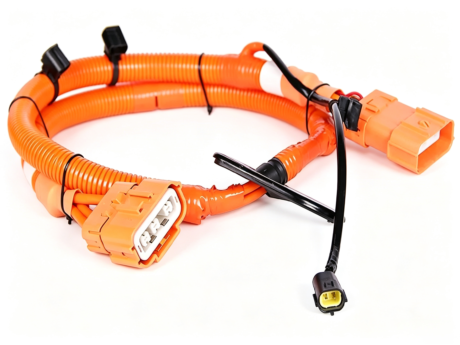
Battery cable assemblies can be classified according to their electrical function, termination, construction, and application.
Positive Battery Cable Assemblies
Positive battery cables carry power from the battery toward the electrical system or load.
They may connect the battery to:
- Starter motors
- Power distribution points
- Alternators
- Fuses
- Electrical control systems
Because positive cables can carry high current, correct conductor sizing and low-resistance connections are critical.
Negative Battery and Ground Cable Assemblies
Negative cables provide the return path to the battery and may connect to the vehicle chassis or equipment ground.
A poor ground connection can cause electrical problems even when the positive cable is correctly sized.
Ground cable assemblies should therefore be evaluated with the same attention to:
- Conductor size
- Terminal quality
- Crimping
- Routing
- Corrosion resistance
- Mechanical retention
Ring-to-Ring Battery Cables
A ring-to-ring battery cable has ring terminals or cable lugs at both ends.
It is commonly used where the cable needs to be securely bolted to two electrical connection points.
Key design parameters include:
- Cable cross-sectional area
- Overall length
- Ring-terminal hole diameter
- Terminal material
- Plating
- Crimp specification
Battery Terminal Cable Assemblies
These assemblies combine a cable with a battery-post terminal at one end.
They are often customized according to:
- Positive or negative connection
- Battery-post configuration
- Cable size
- Cable length
- Terminal orientation
Fuse Link or Fusible Link Battery Cables
Some battery cable assemblies incorporate circuit protection.
The exact protection method depends on the electrical architecture and application requirements.
When integrating protection components, engineers should consider:
- Current rating
- Protection characteristics
- Connection method
- Thermal conditions
- Serviceability
Battery Ground Straps and Flat Ground Cables
Ground straps can be useful where flexibility, grounding, and installation space are important.
They may be used in automotive and equipment applications where the connection must tolerate movement or vibration.
Battery Cable Repair Splices
Repair splices can be used in certain service applications to restore a damaged cable.
The appropriate repair method depends on:
- Cable size
- Current requirements
- Environmental exposure
- Mechanical stress
- Applicable repair specifications
For OEM production, a complete engineered cable assembly may be preferable when long-term consistency and reliability are required.
Booster and Jumper Cable Assemblies
Booster cables are designed for temporary high-current connections between batteries.
They require suitable:
- Cable cross-section
- Insulation
- Clamps
- Mechanical flexibility
- Connection quality
They should not automatically be treated as equivalent to permanently installed battery cable assemblies.
How Do You Choose the Correct Battery Cable Size?
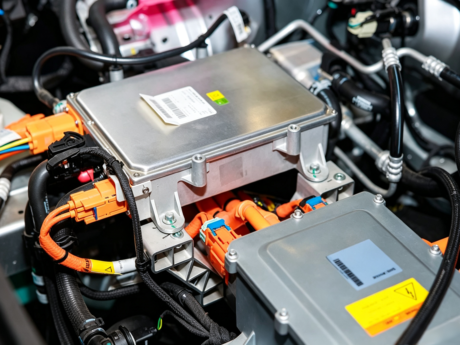
Cable size is one of the most important battery cable design parameters.
Selecting cable size based only on the maximum current is not sufficient. A proper design should consider current, cable length, voltage drop, temperature, installation conditions, and the type of load.
Battery Cable Gauge and Cross-Sectional Area
A larger conductor generally has lower electrical resistance.
A smaller conductor generally has:
- Higher resistance
- Greater voltage drop at the same current
- Greater potential for heat generation
However, simply choosing the largest possible cable is not always the best solution because larger cables can increase:
- Material cost
- Weight
- Installation difficulty
- Bending requirements
- Connector size
The objective is to select a cable that meets the actual application requirements with appropriate engineering margin.
Current Capacity
Consider both:
- Continuous current
- Peak current
Some battery applications have high short-duration starting currents. Starter circuits, for example, can require significantly different cable sizing considerations from low-current auxiliary systems.
The cable should also be evaluated under the actual operating environment.
Cable Length and Voltage Drop
Cable length has a direct effect on total electrical resistance.
As cable length increases, resistance increases.
A simplified relationship is:
Voltage Drop = Current × Resistance
Therefore:
Higher Current + Longer Cable + Higher Resistance = Greater Voltage Drop
This is why a cable that works adequately at a short length may not be appropriate when the same current must travel through a much longer cable.
Voltage-drop requirements should be established early in the design process.
Temperature and Installation Conditions
Cable performance can also be affected by:
- Ambient temperature
- Engine-compartment heat
- Cable bundling
- Ventilation
- Routing
- Nearby heat sources
A cable operating in a hot engine compartment may require different insulation and thermal performance from a cable installed in a controlled indoor environment.
Copper vs. Copper-Clad Aluminum Battery Cable
Conductor material is another important selection factor.
Copper Battery Cable
Copper provides high electrical conductivity and is widely used for battery and power cable applications.
Potential advantages include:
- Good conductivity
- Reliable high-current performance
- Established termination methods
- Good availability
Copper-Clad Aluminum Cable
Copper-clad aluminum combines an aluminum conductor with a copper exterior layer.
Potential benefits can include reduced weight and lower material cost, depending on the design.
However, electrical performance, termination, mechanical requirements, and application suitability need to be evaluated carefully.
For high-current battery applications, conductor selection should be based on the complete engineering requirements rather than price alone.
How Do You Choose Battery Cable Insulation?
The conductor carries current, but the insulation protects the cable and helps determine its environmental suitability.
PVC Battery Cable Insulation
PVC can be suitable for many general-purpose applications.
Potential advantages include:
- Cost efficiency
- Flexibility
- Availability
- Suitable performance for many conventional environments
However, the specific temperature and environmental rating must be verified for the intended application.
XLPE Battery Cable Insulation
XLPE can offer higher temperature capability and strong environmental performance for demanding applications.
It can be considered where the cable may experience:
- Higher temperatures
- Oil exposure
- Abrasion
- Chemical exposure
- Automotive engine-compartment conditions
SGT vs. SGX Battery Cable
SGT and SGX are commonly associated with automotive battery cable constructions, but they differ in insulation characteristics and application suitability.
| Characteristic | SGT | SGX |
| Typical insulation | PVC-based | XLPE-based |
| Temperature capability | Generally lower | Generally higher |
| Flexibility | Good | Good, application-dependent |
| Environmental resistance | Suitable for many general applications | Better suited to more demanding conditions |
| Typical use | General automotive applications | Demanding automotive environments |
| Relative cost | Generally lower | Generally higher |
The correct choice depends on the actual temperature, oil exposure, abrasion, flexibility, and other requirements of the application.
What Terminals Are Used in Battery Cable Assemblies?
A high-quality cable is only as reliable as its termination.
The terminal creates the electrical and mechanical interface between the cable and the battery or electrical equipment.
Ring Terminals and Cable Lugs
Ring terminals and cable lugs are widely used for bolted electrical connections.
Important specifications include:
- Wire size
- Stud size
- Hole diameter
- Material
- Plating
- Crimp design
For high-current battery applications, terminal cross-section and connection quality are particularly important.
Battery Post Terminals
Battery post terminals are designed to connect directly to battery posts.
They may differ according to:
- Positive/negative configuration
- Battery design
- Cable size
- Orientation
- Auxiliary connection requirements
Right-Angle Terminals
Right-angle terminals can be useful when the installation area has limited space.
They can help control cable routing and reduce unnecessary bending.
Plated vs. Unplated Copper Terminals
Plating can improve corrosion resistance depending on the material and environment.
The selection should consider:
- Electrical performance
- Corrosion exposure
- Temperature
- Connection method
- Cost
Crimped vs. Soldered Battery Cable Connections
For custom cable assemblies, termination method is an important engineering consideration.
Crimped Connections
A properly engineered crimp creates a mechanical and electrical connection between the conductor and terminal.
The crimp process should be controlled through:
- Correct terminal
- Correct wire size
- Appropriate tooling
- Correct positioning
- Controlled process parameters
- Inspection and testing
Soldered Connections
Soldering may be appropriate for certain applications or specific component designs.
However, the joining method should be selected based on:
- Terminal design
- Mechanical requirements
- Environmental conditions
- Applicable standards
- Production process
For production battery cable assemblies, the manufacturer should use a joining method that is validated for the specific cable and terminal combination.
What Causes Battery Cable Assembly Failure?
Battery cable failures can result from electrical, mechanical, environmental, or manufacturing problems.
1. Corrosion
Corrosion can occur because of:
- Moisture
- Salt
- Chemical exposure
- Poor sealing
- Environmental contamination
Corrosion can increase electrical resistance and weaken the mechanical connection.
2. Loose Terminals
A loose terminal can increase contact resistance.
This can result in:
- Voltage drop
- Heat generation
- Intermittent operation
- Poor starting performance
3. Damaged Insulation
Insulation can be damaged by:
- Abrasion
- Heat
- Chemicals
- Aging
- Sharp edges
- Excessive bending
Once insulation is compromised, the conductor may become exposed to unwanted electrical or environmental conditions.
4. Undersized Cable
An undersized cable can produce excessive voltage drop and heat under high-current conditions.
Potential symptoms include:
- Reduced electrical performance
- Slow starting
- Excessive cable temperature
- Unstable operation
5. Poor Crimping
Incorrect crimping may result from:
- Wrong terminal
- Wrong tooling
- Incorrect wire size
- Insufficient compression
- Excessive compression
- Incorrect conductor positioning
A poor crimp can increase resistance or reduce mechanical retention.
6. Excessive Cable Length
Longer cable runs have greater resistance.
When current is high, even relatively small increases in resistance can become important.
Therefore, cable length should be optimized based on actual routing requirements rather than simply adding excessive length for convenience.
What Are the Symptoms of a Bad Battery Cable?
A defective battery cable assembly can produce symptoms that overlap with other electrical problems.
Common symptoms can include:
- Slow engine cranking
- Clicking during starting
- Dim lights
- Intermittent electrical operation
- Difficulty starting
- Unstable electrical performance
- Excessive heat near terminals
- Visible corrosion
- Damaged insulation
- Burning smell in severe cases
However, these symptoms do not automatically prove that the cable is defective.
A proper diagnosis should consider the complete electrical system, including:
- Battery condition
- Battery terminals
- Positive cable
- Ground cable
- Starter
- Alternator / charging system
- Related connections
How Do You Inspect and Test a Battery Cable Assembly?
Testing should be selected according to the application and the required performance criteria.
Visual Inspection
Inspect the complete cable assembly for:
- Damaged insulation
- Cracks
- Abrasion
- Corrosion
- Loose terminals
- Deformation
- Heat damage
- Incorrect routing
Check Cable Connections
Pay particular attention to:
- Battery terminals
- Ground points
- Chassis connections
- Starter connections
- Distribution points
Connections should be secure and free from unacceptable contamination or corrosion.
Voltage Drop Testing
Voltage-drop testing is useful for identifying excessive resistance under an operating load.
A voltage-drop measurement can help determine whether resistance is occurring in:
- The cable
- The terminal
- The connection point
- The ground path
This can be more informative than simply measuring resistance with the system unloaded.
Continuity Testing
Continuity testing can help identify an open circuit or broken conductor.
Resistance Testing
Resistance measurements can provide useful information about cable and connection condition, but the measurement method, test equipment, connection quality, and operating conditions should be considered when interpreting results.
When Should You Replace a Battery Cable Assembly?
There is no universal replacement interval for every battery cable assembly.
Replacement should be based on the cable’s actual condition and application requirements.
Potential replacement indicators include:
- Cracked insulation
- Severe corrosion
- Damaged conductors
- Damaged terminals
- Loose connections
- Excessive voltage drop
- Overheating
- Mechanical damage
- Failed electrical testing
- Repeated electrical faults
For commercial vehicles, industrial machinery, and other equipment, cable assemblies may also be inspected according to preventive maintenance schedules.
How Do You Design a Custom Battery Cable Assembly?
A custom battery cable assembly should be designed around the electrical and mechanical requirements of the final product.
A practical design process includes the following steps.
Step 1: Define Electrical Requirements
Establish:
- System voltage
- Continuous current
- Peak current
- Starting current
- Maximum acceptable voltage drop
- Electrical protection requirements
Step 2: Determine Cable Size
Consider:
- Current
- Cable length
- Voltage drop
- Temperature
- Routing
- Bundling
- Installation environment
Step 3: Select Conductor Material
Determine whether the application requires:
- Copper
- Tinned copper
- Another application-specific conductor
Selection should consider conductivity, corrosion resistance, mechanical requirements, and cost.
Step 4: Select Insulation
Consider:
- Temperature
- Oil
- Chemicals
- Moisture
- Abrasion
- Flexibility
- UV exposure where applicable
Step 5: Select Terminals
Specify:
- Terminal type
- Wire size range
- Stud/hole diameter
- Material
- Plating
- Crimp requirements
Step 6: Define Cable Length
Specify:
- Overall cable length
- Terminal-to-terminal dimension
- Branch dimensions if applicable
- Bend requirements
- Routing allowance
Step 7: Add Protection
Depending on the application, use:
- Heat-shrink tubing
- Corrugated tubing
- Braided sleeving
- Protective conduit
- Grommets
- Clips
Step 8: Define Testing Requirements
Testing can include:
- Continuity
- Resistance
- Voltage drop
- Pull force
- Insulation
- Visual inspection
- Functional testing
Custom Battery Cable Assemblies from XSD Harness
XSD Harness provides custom wire harness and cable assembly manufacturing for OEM and industrial applications.
For custom battery cable projects, the manufacturing process can be developed around customer drawings, BOMs, samples, cable specifications, and application requirements.
Custom Cable Processing
Depending on project requirements, manufacturing capabilities can include:
- Wire and cable cutting
- Wire stripping
- Terminal crimping
- Connector assembly
- Heat shrinking
- Protective sleeving
- Cable bundling
- Labeling
Custom Battery Cable Applications
Battery and power cable assemblies can be designed for applications such as:
- Automotive systems
- Electric mobility
- Agricultural machinery
- Industrial equipment
- Battery systems
- Energy storage equipment
Quality and Testing
Depending on the project, quality control can include:
- Continuity testing
- Insulation / withstand voltage testing
- Pull-force testing
- Dimensional inspection
- Visual inspection
- Application-specific testing
The exact inspection and testing plan should be established according to the customer’s drawings, specifications, and application requirements.
Battery Cable Assembly Quality Control Process
A reliable battery cable assembly should be controlled throughout manufacturing.
1. Incoming Material Inspection
Verify:
- Cable specifications
- Terminal specifications
- Connector specifications
- Material condition
- Part numbers
2. Wire Processing Inspection
Check:
- Cable length
- Strip length
- Conductor condition
- Insulation condition
3. Crimping Inspection
Verify:
- Terminal positioning
- Crimp consistency
- Mechanical retention
- Applicable dimensional requirements
4. Final Assembly Inspection
Check:
- Terminal orientation
- Heat-shrink position
- Protection components
- Labels
- Overall dimensions
- Visual appearance
5. Electrical Testing
Depending on the application:
- Continuity
- Resistance
- Voltage drop
- Insulation
- Functional testing
A robust quality system therefore follows:
Incoming Inspection
↓
Wire Processing Control
↓
Crimping & Assembly Control
↓
Final Inspection
↓
Electrical Testing
↓
Shipment
Frequently Asked Questions About Battery Cable Assemblies
What is a battery cable assembly?
A battery cable assembly is a finished power cable component that combines a battery cable with terminals, connectors, protection, and other components required for a specific electrical application.
What is the difference between a battery cable and a battery cable assembly?
A battery cable is generally the cable itself, while a battery cable assembly is a completed, terminated product ready for installation.
How do I choose the correct battery cable gauge?
Consider current, cable length, voltage drop, temperature, routing, bundling, and the operating environment. The correct size should be determined from the complete application rather than current alone.
Does battery cable length affect performance?
Yes. Longer cables have higher resistance, which can increase voltage drop, particularly in high-current applications.
What is the difference between copper and CCA battery cable?
Copper provides high electrical conductivity and is widely used for demanding power applications. Copper-clad aluminum can provide weight and cost advantages in certain applications, but its electrical and mechanical characteristics should be evaluated against the actual requirements.
What is the difference between SGT and SGX battery cable?
SGT and SGX battery cables generally use different insulation constructions and have different temperature and environmental performance characteristics. The correct choice depends on the application.
Which terminals are used in battery cable assemblies?
Common options include battery-post terminals, ring terminals, cable lugs, and right-angle terminals. The terminal should match the cable size, connection point, current requirements, and assembly process.
How do I know if a battery cable is bad?
Possible symptoms include slow starting, intermittent electrical operation, excessive voltage drop, overheating, visible corrosion, damaged insulation, or loose terminals. These symptoms can have other causes, so the complete electrical system should be checked.
How do I test a battery cable assembly?
Depending on the application, testing can include visual inspection, continuity testing, resistance measurement, voltage-drop testing, insulation testing, mechanical pull testing, and functional testing.
Can a battery cable assembly be custom manufactured?
Yes. Custom battery cable assemblies can be produced according to cable size, length, terminals, connectors, insulation, protection, routing, testing, and quantity requirements.
What information is needed to quote a custom battery cable?
A manufacturer will typically need the cable specification, length, conductor size, terminals, connectors, quantity, application, and testing requirements. A drawing, BOM, 3D model, or sample can make quotation and engineering review more accurate.
Can a wire harness manufacturer produce battery cable assemblies?
Yes. A wire harness manufacturer with appropriate cable-processing, crimping, assembly, and testing capabilities can manufacture custom battery cable assemblies as part of its cable assembly capabilities.
Conclusion: A Reliable Battery Cable Assembly Starts With the Right Design
A reliable battery cable assembly requires more than choosing a sufficiently thick cable.
The complete assembly needs to be engineered around:
Conductor → Cable Size → Insulation → Length → Terminals → Crimping → Protection → Routing → Testing
The correct cable size helps control current capacity and voltage drop. Appropriate insulation protects the cable from its operating environment. Correct terminals and controlled crimping provide reliable electrical and mechanical connections. Proper routing and protection help prevent mechanical and environmental damage.
For OEMs, equipment manufacturers, and product developers, working with an experienced cable assembly manufacturer can also help identify manufacturing issues before they become production problems. Contact us for more information.