
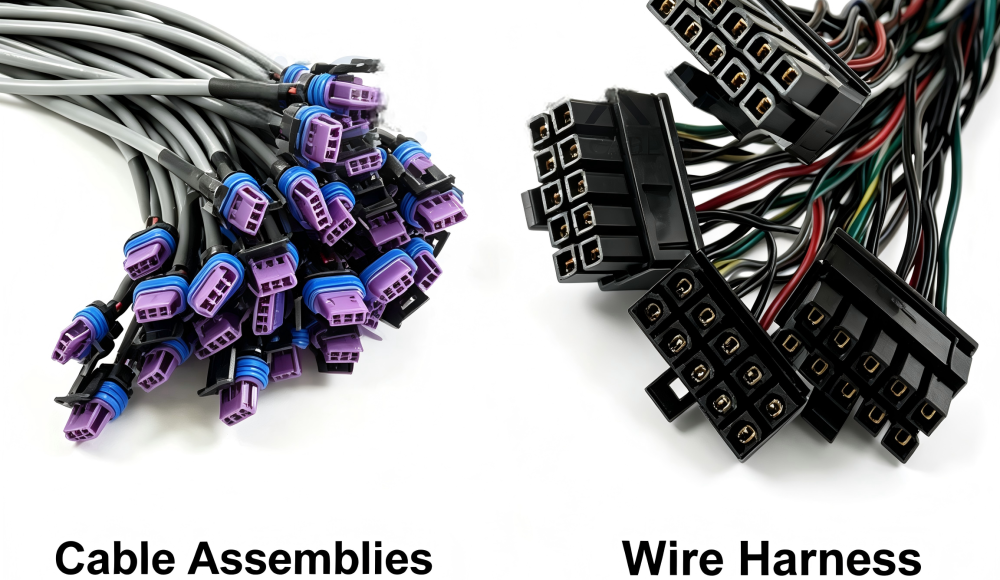
A wire harness is generally designed to organize and route multiple individual wires, while a cable assembly typically combines one or more conductors with additional protection such as an outer jacket, shielding, or overmolding. The right choice depends on the operating environment, electrical requirements, mechanical stress, protection level, and production budget.
For example, a wire harness may be the most economical solution for internal wiring inside an appliance, control cabinet, or vehicle. A custom cable assembly may be a better choice for outdoor equipment, industrial automation, medical devices, marine systems, or applications exposed to moisture, vibration, abrasion, and electromagnetic interference (EMI).
So, what is the difference between a wire harness and a cable assembly? Which option is better for your application? And how can you choose a reliable wire harness or cable assembly manufacturer?
This guide explains the differences between wire harnesses and cable assemblies, their construction, applications, technical specifications, manufacturing processes, costs, certifications, and key factors to consider before requesting a quotation.
1. What Is a Wire Harness?
1.1 Definition of a Wire Harness
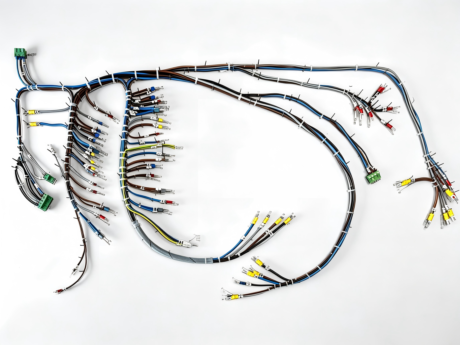
A wire harness, also called a wiring harness or wire harness assembly, is a group of individual wires organized into a structured assembly.
The wires are typically arranged according to a specific circuit or wiring diagram and secured using materials such as:
- Cable ties
- Electrical tape
- Braided sleeving
- Corrugated tubing
- PVC tubing
- Protective sleeves
- Clips and brackets
- Labels
Each individual wire may be cut to a specific length, stripped, crimped with a terminal, and connected to a connector housing.
The main purpose of a wire harness is to organize electrical circuits and simplify installation.
Instead of installing dozens of individual wires separately, an assembled harness allows multiple circuits to be installed as one organized unit.
A typical custom wire harness may include:
- Single-core or multi-core wires
- Power wires
- Signal wires
- Ground wires
- Crimp terminals
- Ring terminals
- Spade terminals
- Quick-disconnect terminals
- Connector housings
- Fuse holders
- Relays
- Cable ties
- Protective tubing
- Identification labels
The exact configuration depends on the product and application.
1.2 How Does a Wire Harness Work?
A wire harness provides an organized pathway for electrical power and signals.
Each wire performs a specific function within the system. For example, a harness may contain separate conductors for:
- Power transmission
- Grounding
- Sensors
- Data signals
- Control circuits
- Communication
The wires are cut to predetermined lengths and terminated with suitable connectors or terminals.
During installation, the entire harness can be routed through the equipment according to its predefined shape and connection points.
This offers several advantages over manually installing individual wires.
A well-designed wire harness can:
- Reduce installation time
- Prevent wiring errors
- Simplify assembly
- Improve circuit organization
- Reduce the risk of incorrect connections
- Make maintenance easier
For manufacturers producing equipment at scale, a custom wiring harness can significantly improve production efficiency.
1.3 Advantages of Wire Harnesses
Lower Cost
Wire harnesses are often less expensive than fully jacketed or overmolded cable assemblies.
Their relatively simple construction requires fewer protective materials and less complex processing.
This makes them suitable for cost-sensitive applications where the wiring is installed in a relatively controlled environment.
Lightweight Construction
Because a wire harness may not require a thick outer jacket, it can be lighter and more flexible.
This is valuable in applications where weight and routing space are important.
Flexible Routing
Individual wires within a harness can often be routed around equipment more easily than a thick cable assembly.
This is useful for complex internal wiring systems with limited installation space.
Easy Maintenance and Modification
Wire harnesses can generally be accessed more easily than sealed cable assemblies.
If a circuit needs to be modified or repaired, individual wires or terminals may be replaced without replacing the entire assembly.
Efficient Installation
A preassembled harness can be installed as a complete unit.
This reduces manual wiring work and improves assembly consistency.
1.4 Limitations of Wire Harnesses
The primary limitation of a standard wire harness is environmental protection.
Depending on its construction, an exposed harness may have limited resistance to:
- Water
- Dust
- Chemicals
- Abrasion
- Oil
- Extreme temperatures
- Continuous vibration
For applications exposed to harsh environments, additional protective measures may be required.
These can include:
- Protective conduit
- Braided sleeving
- Corrugated tubing
- Heat-shrink tubing
- Sealing boots
If the application requires a fully sealed or IP-rated connection, a cable assembly with a protective jacket or overmolded connector may be more appropriate.
2. What Is a Cable Assembly?
2.1 Definition of a Cable Assembly
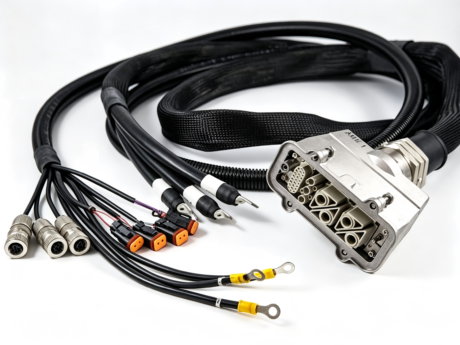
A cable assembly is a finished electrical connection system consisting of one or more cables or conductors combined with connectors and protective components.
Compared with a basic wire harness, a cable assembly typically provides a higher level of mechanical and environmental protection.
A custom cable assembly may include:
- Conductors
- Insulation
- Shielding
- Outer jackets
- Connectors
- Backshells
- Strain relief
- Overmolded sections
- Waterproof seals
The finished assembly functions as an integrated cable system that can be installed directly into equipment.
Cable assemblies are often used when the wiring must withstand more demanding operating conditions.
2.2 How Is a Cable Assembly Constructed?
A cable assembly can be designed in many different ways depending on its application.
The basic construction may include:
Conductors
Conductors carry electrical power or signals.
Copper is commonly used because of its excellent electrical conductivity. Other conductor materials may be selected for specific performance requirements.
Insulation
Insulation separates conductors electrically and protects them from environmental exposure.
The material may be selected based on:
- Voltage
- Temperature
- Flexibility
- Chemical exposure
- Mechanical requirements
Shielding
Shielding is used when protection against electromagnetic interference is required.
Common shielding methods include:
- Foil shielding
- Braided copper shielding
- Combination foil and braid shielding
Outer Jacket
The outer jacket protects the internal conductors from the surrounding environment.
Common jacket materials include:
- PVC
- PUR
- TPE
- TPU
- Silicone
Connectors
Cable assemblies may use various connector types, including:
- Circular connectors
- Rectangular connectors
- Waterproof connectors
- Multi-pin connectors
- High-voltage connectors
- Industrial connectors
Overmolding
Overmolding involves molding a protective material directly around the connector or cable termination.
It can provide:
- Strain relief
- Mechanical protection
- Water resistance
- Improved durability
- A cleaner appearance
2.3 Common Cable Assembly Materials
The appropriate jacket material depends on the operating environment.
PVC
PVC is widely used because it is economical and versatile.
It is suitable for many indoor and general-purpose applications.
PUR
PUR offers excellent resistance to:
- Abrasion
- Oil
- Mechanical stress
It is often considered for industrial applications and dynamic cable systems.
TPE
TPE provides a balance of flexibility, durability, and environmental resistance.
Silicone
Silicone is known for excellent flexibility and a broad operating temperature range.
It may be suitable for applications requiring high-temperature resistance or repeated flexing.
2.4 Advantages of Cable Assemblies
Better Environmental Protection
A protective jacket can shield internal conductors from:
- Moisture
- Dust
- Chemicals
- Abrasion
- Vibration
Improved Mechanical Durability
Cable assemblies are generally better suited to applications involving repeated movement or mechanical stress.
EMI/EMC Protection
Shielded cable assemblies can reduce electromagnetic interference and help maintain signal integrity.
This is particularly important for:
- Data communication
- Industrial automation
- Medical electronics
- Sensors
- High-speed signals
Longer Service Life
When properly designed for the operating environment, a cable assembly can provide a longer service life than an exposed wiring harness.
2.5 Limitations of Cable Assemblies
Cable assemblies also have some disadvantages.
They are generally:
- More expensive
- More complex to manufacture
- More difficult to modify
- Less accessible for field repair
- Potentially less flexible depending on construction
Once a cable assembly is sealed or overmolded, replacing an individual conductor may not be practical.
Therefore, the design should be finalized carefully before production.
3. Wire Harness vs. Cable Assembly: What Is the Difference?
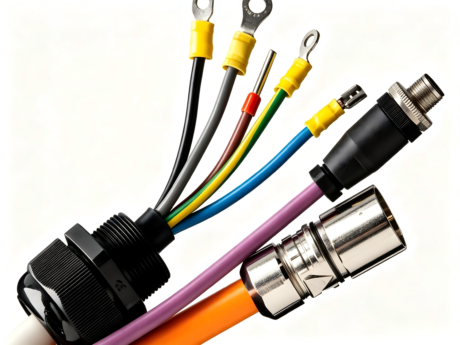
The fundamental difference between a wire harness and a cable assembly is their construction and level of protection.
A wire harness primarily organizes individual wires into a structured assembly.
A cable assembly generally combines conductors with additional protective elements such as jackets, shielding, sealing, and overmolding.
However, the distinction is not always absolute. Some wire harnesses can include protective tubing, sleeving, or shielding, while some cable assemblies may contain only a small number of conductors.
The best way to understand the difference is to compare their major characteristics.
3.1 Construction Difference
Wire Harness
Typically consists of multiple individual wires organized with:
- Tape
- Cable ties
- Sleeves
- Tubing
- Clips
Cable Assembly
Typically consists of:
- One or more cables
- Protective insulation
- Outer jacket
- Connectors
- Shielding
- Overmolding
3.2 Protection Difference
A standard wire harness generally provides limited environmental protection.
A cable assembly can provide significantly greater protection through:
- Outer jackets
- Shielding
- Sealing
- Overmolding
- Strain relief
For outdoor or harsh industrial environments, cable assemblies are often preferred.
3.3 Flexibility and Serviceability
Wire harnesses are often easier to:
- Route
- Modify
- Repair
- Rework
Cable assemblies may be more difficult to modify once they have been sealed or overmolded.
However, the additional protection of a cable assembly can provide greater reliability in demanding applications.
3.4 Cost Difference
A wire harness is typically more economical because it requires fewer materials and simpler manufacturing processes.
A cable assembly may cost more because of:
- Protective jackets
- Shielding
- Specialized connectors
- Overmolding
- Waterproof sealing
- Additional testing
The cheapest option is not necessarily the most economical over the entire product lifecycle.
If a low-cost wire harness fails repeatedly in a harsh environment, the cost of maintenance and replacement may exceed the initial savings.
3.5 Reliability and Service Life
The expected service life depends on the environment.
A wire harness can provide excellent reliability when installed in a protected location.
A cable assembly is generally better suited to applications exposed to:
- Moisture
- Vibration
- Abrasion
- Temperature changes
- Chemicals
The correct solution is therefore determined by the actual operating conditions.
3.6 Wire Harness vs. Cable Assembly Comparison
| Feature | Wire Harness | Cable Assembly |
| Basic Construction | Individual wires organized into a bundle | Conductors enclosed in protective cable construction |
| Protection | Low to moderate | Moderate to high |
| Outer Jacket | Usually not required | Commonly used |
| Shielding | Optional | Common for EMI-sensitive applications |
| Waterproofing | Limited unless additional protection is added | Can be designed for sealed applications |
| Flexibility | Generally high | Depends on cable construction |
| Maintenance | Easier to access and modify | More difficult after sealing or overmolding |
| Cost | Usually lower | Usually higher |
| Manufacturing Complexity | Lower | Higher |
| Harsh Environment | Limited unless specially protected | Generally more suitable |
| Typical Applications | Internal equipment wiring | Outdoor, industrial, medical, automotive |
| Best For | Cost-effective organized wiring | Durable and protected connections |
4. Wire Harness vs. Cable Assembly: Technical Specifications
The construction difference is only one part of the decision.
Engineers must also consider the technical requirements of the application.
4.1 Voltage Rating
The voltage rating depends on:
- Conductor insulation
- Cable construction
- Connector rating
- Creepage and clearance
- Application requirements
Low-voltage wire harnesses are common in electronics and control systems.
Higher-voltage applications may require specialized cable assemblies with:
- Thicker insulation
- Specialized connectors
- Greater creepage and clearance
- Additional safety testing
For electric vehicles, battery systems, and industrial power equipment, the cable assembly must be designed specifically for the required voltage and current.
4.2 Temperature Rating
Temperature resistance depends heavily on the wire insulation and jacket material.
Common materials have different temperature capabilities.
For example:
- PVC is widely used for general-purpose applications.
- PUR provides good mechanical resistance.
- Silicone offers excellent flexibility and broad temperature performance.
- TPE provides a balance of flexibility and durability.
The operating temperature should include both the ambient temperature and any heat generated by the electrical load.
4.3 Wire and Cable Gauge
Wire gauge affects:
- Current capacity
- Voltage drop
- Heat generation
- Physical size
- Flexibility
Larger conductors are typically needed for higher current applications.
The correct wire size should be selected based on:
- Continuous current
- Peak current
- Cable length
- Ambient temperature
- Installation method
- Voltage drop requirements
4.4 Connector Options
The connector is a critical part of any harness or cable assembly.
Common options include:
- Ring terminals
- Spade terminals
- Butt connectors
- Quick-disconnect terminals
- Rectangular connectors
- Circular connectors
- Waterproof connectors
- Multi-pin connectors
The connector should be selected based on:
- Current rating
- Voltage rating
- Number of contacts
- Environmental requirements
- Mating cycles
- Space limitations
4.5 Shielding
Shielding is important when electrical signals may be affected by electromagnetic interference.
Common shielding methods include:
Foil Shielding
Provides broad coverage and is often used for signal and communication cables.
Braided Shielding
Provides mechanical strength and effective shielding while maintaining flexibility.
Combination Shielding
Uses both foil and braid for demanding applications.
Shielding may be particularly important for:
- Industrial automation
- Medical electronics
- Communication systems
- Data transmission
- Sensors
- Motor control systems
4.6 IP Protection and Sealing
For applications exposed to water and dust, an IP-rated design may be required.
Depending on the construction, a cable assembly can be designed for high levels of environmental protection.
Applications may require:
- Splash resistance
- Dust resistance
- Waterproofing
- Temporary water immersion protection
The required IP rating should be defined according to the actual installation environment.
4.7 Bend Radius and Flexibility
Cable flexibility is often overlooked during product design.
A cable that is too stiff may create:
- Excessive stress
- Connector damage
- Conductor fatigue
- Premature failure
For moving applications, engineers should consider:
- Dynamic bending
- Static bending
- Repeated flexing
- Torsion
- Minimum bend radius
Applications such as robotics and automated machinery may require specially designed continuous-flex cable assemblies.
5. Where Are Wire Harnesses Used?
Wire harnesses are widely used in applications where wiring needs to be organized but does not require a highly rugged outer structure.
5.1 Automotive Wire Harnesses
Wire harnesses are used throughout vehicles for:
- Interior systems
- Lighting
- Dashboard systems
- Door systems
- Sensors
- Power distribution
Automotive harnesses may include protective tubing, clips, and connectors to withstand vehicle vibration and temperature changes.
5.2 Consumer Electronics
Common applications include:
- Washing machines
- Refrigerators
- Air conditioners
- Home appliances
- Audio equipment
The harness organizes internal wiring and simplifies final assembly.
5.3 Medical Equipment
Wire harnesses can be used inside:
- Diagnostic equipment
- Monitoring systems
- Laboratory equipment
- Electronic medical devices
In these applications, accurate wiring and traceability are often important.
5.4 Industrial Control Systems
Wire harnesses are commonly used inside:
- Control cabinets
- PLC systems
- Automation equipment
- Machinery
The harness allows multiple circuits to be assembled and installed efficiently.
5.5 Renewable Energy and Battery Systems
Depending on environmental exposure, harnesses may be used in:
- Battery packs
- Energy storage equipment
- Solar equipment
- Electrical control systems
The required protection level should be evaluated based on whether the wiring is installed indoors or outdoors.
6. Where Are Cable Assemblies Used?
Cable assemblies are often selected when electrical connections must withstand more demanding environments.
6.1 Automotive and EV Applications
Modern vehicles increasingly require specialized cable assemblies for:
- Battery systems
- Charging systems
- Sensors
- Motor systems
- Communication
- High-voltage power
EV applications may require additional requirements related to voltage, temperature, vibration, shielding, and safety.
6.2 Industrial Automation
Cable assemblies are common in:
- Robotics
- CNC machines
- Motion control
- Sensors
- Factory automation
Applications involving continuous movement may require flexible cable constructions.
6.3 Medical Equipment
Custom cable assemblies may be used in:
- Diagnostic systems
- Imaging equipment
- Patient monitoring
- Laboratory instruments
Depending on the application, the assembly may require specialized materials, shielding, or cleaning resistance.
6.4 Aerospace and Defense
These applications may require:
- Lightweight construction
- High reliability
- Vibration resistance
- Temperature resistance
- Strict traceability
Specialized cable assemblies may be designed to meet specific industry requirements.
6.5 Marine Applications
Marine systems expose electrical connections to:
- Moisture
- Salt
- Vibration
- Corrosion
Sealed cable assemblies are often preferred for marine electronics and control systems.
6.6 Outdoor and Energy Applications
Cable assemblies are widely used in:
- Solar power systems
- Telecom equipment
- Wind energy
- Outdoor automation
- Energy storage
The protective jacket and sealing design help extend service life in demanding environments.
7. How Are Wire Harnesses and Cable Assemblies Manufactured?
7.1 Engineering and DFM Review
Before production, engineers review:
- Drawings
- Wiring diagrams
- BOM
- Connector specifications
- Terminal specifications
- Wire sizes
- Cable lengths
- Tolerances
The goal is to identify potential manufacturing problems before production begins.
7.2 Wire and Cable Cutting
Automated cutting equipment can cut wires and cables to precise lengths.
Accurate cutting is important because incorrect wire length can affect:
- Assembly
- Routing
- Connector position
- Installation
7.3 Wire Stripping
The insulation is removed from the wire end to expose the conductor.
The stripping process must avoid damaging the conductor.
7.4 Terminal Crimping
Terminals are attached using controlled crimping equipment.
A proper crimp should provide:
- Strong mechanical connection
- Reliable electrical conductivity
- Consistent quality
Professional manufacturers may perform crimp height measurements and pull-force testing.
7.5 Connector Assembly
Terminals are inserted into connector housings according to the wiring diagram.
The manufacturer verifies:
- Pin location
- Polarity
- Terminal seating
- Connector locking
Incorrect pin placement can cause serious system failures, making this a critical quality-control step.
7.6 Harness Bundling
For wire harnesses, wires may be organized using:
- Tape
- Cable ties
- Sleeving
- Corrugated tubing
- Protective conduit
The harness is shaped to match the installation environment.
7.7 Cable Jacketing and Overmolding
For cable assemblies, additional processes may include:
- Jacket extrusion
- Shielding
- Connector termination
- Overmolding
- Strain relief
- Sealing
Overmolding can protect the connection between the cable and connector from mechanical and environmental stress.
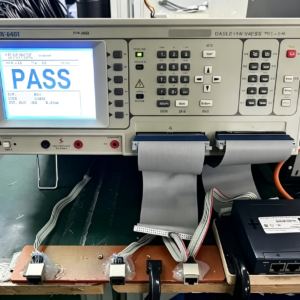
7.8 Electrical Testing
Testing may include:
Continuity Testing
Confirms that each circuit is electrically connected.
Open and Short Testing
Detects broken or incorrectly connected circuits.
Miswire Testing
Confirms that wires are connected to the correct pins.
Hi-Pot Testing
Used when required to verify insulation integrity.
Insulation Resistance Testing
Measures resistance between conductors or between conductors and ground.
The testing requirements should be defined according to the application.
7.9 Final Inspection and Packaging
Before shipment, the manufacturer may inspect:
- Connector condition
- Wire length
- Terminal position
- Labels
- Dimensions
- Workmanship
Proper packaging is also important to prevent connector damage and cable deformation during transportation.
8. Wire Harness vs. Cable Assembly: Which One Should You Choose?
Quick Decision Guide
| Your Requirement | Recommended Solution |
| Low-cost internal wiring | Wire Harness |
| Easy modification and repair | Wire Harness |
| Complex internal routing | Wire Harness |
| Harsh outdoor environment | Cable Assembly |
| Waterproof protection | Cable Assembly |
| EMI shielding | Shielded Cable Assembly |
| High mechanical protection | Cable Assembly |
| Long-term environmental exposure | Cable Assembly |
| High-volume internal equipment wiring | Wire Harness |
| Specialized custom connection | Either, depending on requirements |
The most important question is not “Which is better?” but rather:
“Which solution is better suited to the environment and function of my product?”
9. How Much Does a Wire Harness or Cable Assembly Cost?
The price of a custom wire harness or cable assembly depends on many variables.
There is no standard price that applies to every project.
9.1 Main Cost Factors
Wire or Cable Type
Specialized cables typically cost more than standard wires.
Wire Gauge
Larger conductors require more material and may increase the overall cost.
Cable Length
Longer assemblies require more material and may increase processing time.
Number of Circuits
More wires generally mean more cutting, stripping, crimping, and testing.
Connector Type
Specialized or high-performance connectors can significantly affect the price.
Shielding
Foil or braided shielding adds material and manufacturing costs.
Overmolding
Custom overmolding requires tooling and additional processing.
Waterproofing
Sealing and IP-rated construction increase manufacturing complexity.
Testing
Advanced testing requirements can add cost but may be necessary for critical applications.
Production Quantity
Prototype quantities usually have a higher unit cost than mass production because setup and engineering costs are distributed across fewer parts.
9.2 Why Are Cable Assemblies Usually More Expensive?
Compared with a basic wire harness, a cable assembly may require:
- Additional insulation
- Outer jackets
- Shielding
- Specialized connectors
- Overmolding
- Sealing
- Strain relief
- Additional testing
These features increase manufacturing costs but can significantly improve reliability.
Therefore, customers should evaluate total cost of ownership, not only the initial purchase price.
10. What Information Do You Need to Request a Wire Harness or Cable Assembly Quote?
To receive an accurate quotation, provide as much technical information as possible.
A professional manufacturer may request:
2D Engineering Drawings
These define dimensions, tolerances, and assembly requirements.
3D CAD Files
Useful for understanding complex geometry and physical routing.
Wiring Diagrams
Show how individual circuits are connected.
BOM
A Bill of Materials identifies the required components.
Wire Specifications
Include:
- Wire type
- Gauge
- Insulation
- Color
- Length
Connector Part Numbers
Exact connector information helps ensure compatibility.
Terminal Specifications
Include the required terminal type and crimp requirements.
Cable Length
Specify overall length and, where necessary, individual branch lengths.
Pinout Information
Clearly define which wire connects to which connector pin.
Shielding Requirements
Specify whether foil, braid, or other shielding is required.
Overmolding Requirements
Provide details about:
- Material
- Shape
- Color
- Dimensions
- Sealing requirements
Quantity
Provide both prototype and expected production quantities if possible.
Required Certifications
Specify any requirements such as:
- IPC/WHMA-A-620
- ISO 9001
- IATF 16949
- UL
- RoHS
- REACH
Delivery Requirements
Include:
- Required sample date
- Production schedule
- Delivery location
- Packaging requirements
The more complete the information, the more accurate the quotation and lead-time estimate will be.
11. Frequently Asked Questions About Wire Harnesses and Cable Assemblies
1. Are wire harnesses and cable assemblies the same thing?
No. A wire harness primarily organizes multiple wires into a structured assembly, while a cable assembly generally incorporates additional protection such as jackets, shielding, sealing, or overmolding. However, the terminology can vary between manufacturers and industries.
2. What is the main difference between a wire harness and cable assembly?
The main difference is the level of protection and construction. Wire harnesses are typically designed for organized internal wiring, while cable assemblies are generally designed to provide greater environmental and mechanical protection.
3. Which is cheaper: a wire harness or cable assembly?
A basic wire harness is usually less expensive because it requires fewer materials and simpler manufacturing. A cable assembly generally costs more because of additional jackets, shielding, connectors, overmolding, and testing.
4. Is a cable assembly more durable than a wire harness?
In many applications, yes. A properly designed cable assembly can provide greater resistance to moisture, abrasion, vibration, and other environmental stresses. However, the actual durability depends on the materials and construction.
5. Can a wire harness be waterproof?
A standard open wire harness is generally not fully waterproof. However, additional protective components such as sealed connectors, conduit, heat-shrink tubing, and protective jackets can improve environmental resistance.
6. When should I use a shielded cable assembly?
A shielded cable assembly is typically considered when electromagnetic interference could affect signal quality or system performance. Common applications include industrial automation, medical electronics, communication equipment, and sensitive sensors.
7. Are wire harnesses suitable for automotive applications?
Yes. Wire harnesses are widely used in automotive systems. However, the design must account for vibration, temperature, abrasion, chemicals, and other environmental conditions.
8. Can cable assemblies be customized?
Yes. Custom cable assemblies can be manufactured according to specific requirements for cable type, length, connector, pinout, shielding, overmolding, sealing, and testing.
9. What information is needed to manufacture a custom wire harness?
A manufacturer typically needs drawings, wiring diagrams, BOMs, wire specifications, connector information, terminal details, quantities, and testing requirements. Existing samples can also be useful for reverse engineering or reference.
10. How long does it take to manufacture a custom wire harness or cable assembly?
Lead time depends on complexity, component availability, tooling, testing, and order quantity. Prototype projects generally take less time than large production orders, but the exact schedule should be confirmed after reviewing the project specifications.
11. What certifications should a wire harness manufacturer have?
The appropriate certifications depend on the application. ISO 9001 is commonly used for quality management, while IPC/WHMA-A-620 is a key workmanship standard. Automotive projects may require IATF 16949, and additional certifications may apply to specific industries or markets.
12. How do I choose the right wire harness or cable assembly manufacturer?
Look for a manufacturer with relevant production equipment, engineering expertise, quality-control systems, testing capabilities, material sourcing experience, and the ability to support your required production volume.
Conclusion: Wire Harness or Cable Assembly—Which Is Right for Your Project?
The choice between a wire harness and a cable assembly ultimately depends on the requirements of your application.
A wire harness is often the better choice when you need:
- Cost-effective wiring
- Organized circuits
- Lightweight construction
- Flexible routing
- Easy maintenance
- Internal equipment wiring
A cable assembly is generally more suitable when you need:
- Environmental protection
- Waterproofing
- Mechanical durability
- EMI/EMC shielding
- Resistance to vibration and abrasion
- Long-term reliability
Neither option is universally better.
Need help choosing between a custom wire harness and cable assembly?
Send us your 2D drawings, 3D CAD files, wiring diagrams, BOM, or existing samples. Our engineering team can review your requirements, provide DFM feedback, recommend a suitable wiring solution, and prepare a competitive quotation for prototype and production quantities.
Whether you need a simple internal wire harness or a fully protected custom cable assembly, the right manufacturing partner can help you achieve the ideal balance of cost, performance, reliability, and service life.